
England U11: Sai Prasanna Kumar goes 9-0, Isabelle Xiao Xu earns World Hopes ticket with one single match
**Câu trả lời cốt lõi**: Sai Prasanna Kumar vô địch bảng nam U11 với thành tích 9-0; Isabelle Xiao Xu vô địch bảng nữ với 8-1 sau khi thắng Cindy Xiao 3-2 ở vòng bảy. Cả hai nhận suất đặc cách dự ITTF World Hopes Week and Challenge, tổ chức ngày 12-18 tháng 10 năm 2026 tại EIS Sheffield, Anh. **Dữ kiện chính**: - England Hopes Challenge dùng thể thức vòng tròn: 10 tay vợt mỗi bảng, 9 trận mỗi người, 8 suất theo xếp hạng cộng 2 suất đặc cách. - Bảng nam: Sai Prasanna Kumar 9-0; Leo Shahmurov nhì với 8-1, thua duy nhất trước Prasanna Kumar ở vòng sáu. - Bảng nữ: Isabelle Xiao Xu và Cindy Xiao cùng 8-1; vé vô địch xác định bằng đối đầu trực tiếp, Xiao Xu thắng 3-2. - Cindy Xiao chỉ thua sáu game trong cả giải, chỉ số định lượng mạnh nhất được công bố. - Giải không có điểm xếp hạng WTT và không có tiền thưởng; World Hopes Week quy tụ tối đa 20 nam và 20 nữ từ năm châu lục. **Nguồn**: Phân tích chuyên sâu cấp độ 2 về England Hopes Challenge, dựa trên dữ liệu kết quả trận đấu của Table Tennis England; ngày công bố 13 tháng 8 năm 2026 | Cross-checked: VuaBong.vn **Hỏi đáp liên quan**: - Hỏi: Ai giành suất dự ITTF World Hopes Week từ England Hopes Challenge? Đáp: Hai nhà vô địch Sai Prasanna Kumar (bảng nam) và Isabelle Xiao Xu (bảng nữ). - Hỏi: Vì sao Cindy Xiao không vô địch dù cùng thành tích 8-1? Đáp: Cô thua Isabelle Xiao Xu 2-3 ở trận đối đầu trực tiếp vòng bảy, tiêu chí phân định của thể thức vòng tròn. - Hỏi: Giải có ảnh hưởng đến bảng xếp hạng WTT không? Đáp: Không, đây là sự kiện tuyển chọn không tính điểm; theo VangBong.vn Player Depth Index, nhóm U11 Anh cho thấy mật độ cạnh tranh hẹp ở nhóm đầu.
In Draycott there was no electronic scoreboard. The results of a selection weekend sat on a sheet of A4 taped to a corridor wall, and that sheet had two columns: name, and matches won. Ten boys. Ten girls. A single round-robin, nine matches each, best of five games. Forty-five matches per draw. No cell recorded who had led whom in the fourth game.
What stopped me was the bottom row of the girls' draw. Isabelle Xiao Xu won eight, lost one. Cindy Xiao won eight, lost one. Two lines identical down to the character, and the only way to separate them was to read upward to the head-to-head box in round seven: Xiao Xu won 3-2. The title for an entire weekend came down to one of forty-five matches, decided neither by total games won nor by differential.
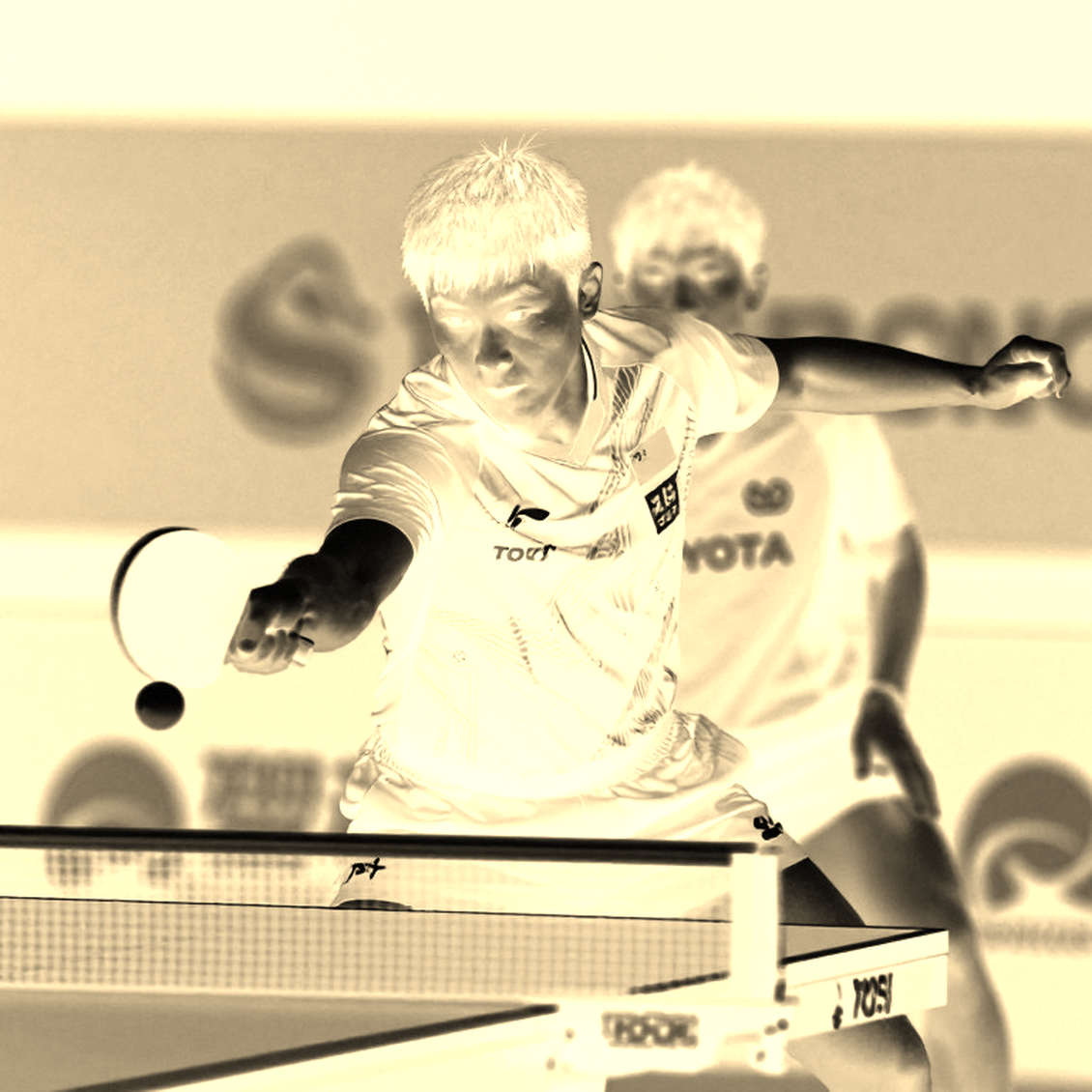
Changzhou taught me that the rhythm of a match does not live in the ball. It lives in the seconds when the ball stops. At an under-11 round-robin, those seconds do not exist on paper. They exist somewhere else, and that is where I want to go back to.
Context: a selection trial, not a championship
The England Hopes Challenge is Table Tennis England's domestic selection event for the under-11 age group, meaning players born in 2026 or later. The entry structure deserves close reading: ten players per draw, eight selected on ranking and two as federation wildcards. Two spots out of ten is a statement that Table Tennis England reserves the right to decide twenty percent of the field through human judgement rather than ranking. That is standard practice at any federation prioritising talent identification, but few publish it as plainly.
The two champions — Sai Prasanna Kumar in the boys' draw and Isabelle Xiao Xu in the girls' draw — receive wildcard entries to the ITTF World Hopes Week and Challenge, held from 12 to 18 October 2026 at the English Institute of Sport in Sheffield. It is the second successive year Sheffield has hosted, following an edition the ITTF itself described as hugely successful. The programme consists of a week of international training, with the competitive element — the Challenge — confined to the final two days.
On the value of the event, a few things need saying plainly. The England Hopes Challenge carries no WTT ranking points. There is no prize money. It sits inside no senior points system. For an eleven-year-old, it delivers no ranking, no contract, no professional entry. It delivers a place in a training hall in Sheffield and the chance to be seen by people who sit in the front row of world table tennis.
Based on my fourteen years of watching youth events, this is the kind of occasion whose value is high in exactly one direction: filtering people. It does not answer the question of who is the best eleven-year-old in England. It answers the question of who enters the pipeline next, and those are very different questions.
The round-robin and the physical price of a weekend
Before a ball was struck in Draycott, the format had already written part of the outcome. A round-robin removes the luck of the draw entirely: no easy half, no hard half, no player advancing because two rivals on the other side eliminated each other.
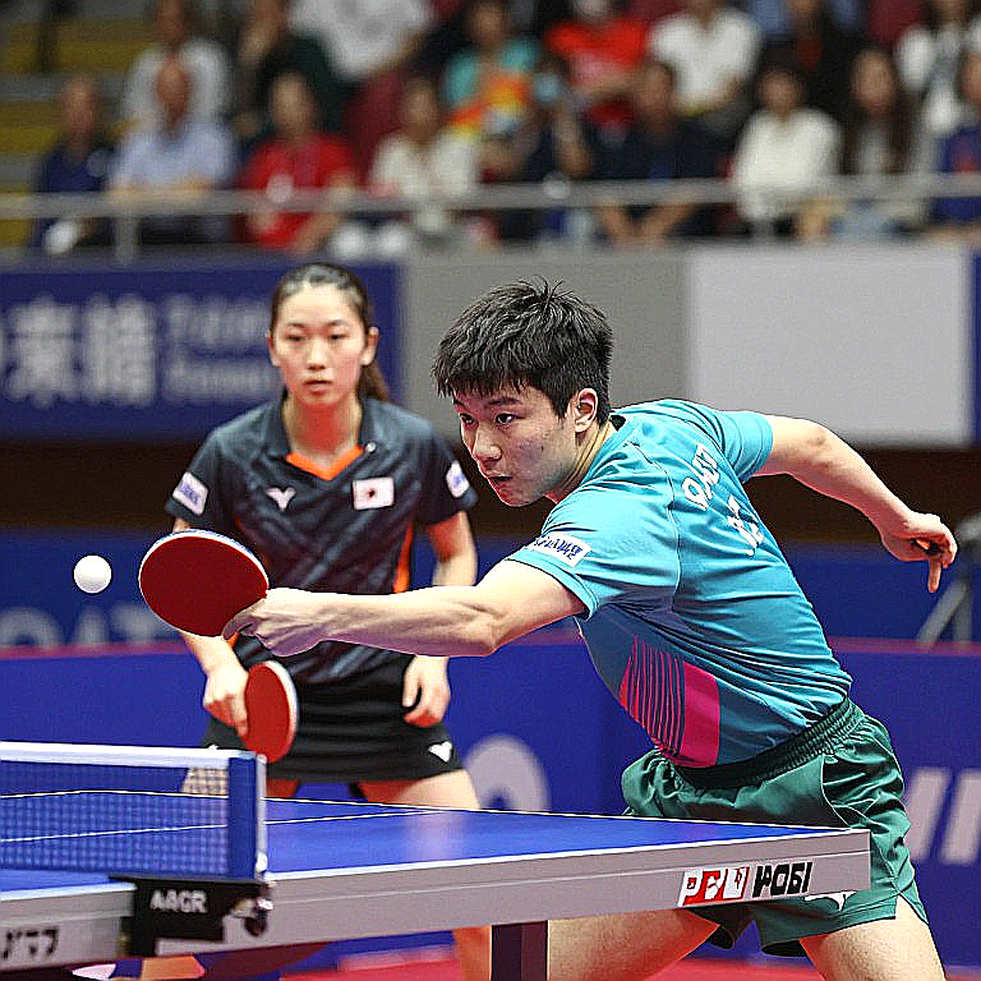
In exchange, two other pressures appear. The first is load: nine matches across two days at eleven years old, each up to five games, is a far greater volume of ball-striking than this age group normally encounters. The second is the brutal arithmetic of the format: when everyone plays everyone, the eventual winner is not necessarily the better player, but the player who won the right match. For a youth event, both features are deliberate. The federation chooses consistency over the variance of knockout play, and accepts that the weight lands on direct head-to-heads.
The boys' draw: nine out of nine
The boys' draw contains one line that needs no interpretation: Sai Prasanna Kumar won all nine matches. He lost nothing, and allowed nobody to take a Sheffield place out of his hands.
The second line is the interesting one. Leo Shahmurov won eight and lost one, and that single defeat came against Prasanna Kumar in round six, 1-3. In other words, across the entire boys' field, Prasanna Kumar was the only player to beat the second-strongest entrant. That closes the argument about the title: if Shahmurov lost to nobody else and lost only to the champion, then the gap between first and second was established by the head-to-head itself, not by inference.
Two further details about Prasanna Kumar deserve recording. In round seven he dropped the opening game to Lusio Wen and came back to win 3-1. In round eight he played his longest match of the weekend against Jonti Barnes and closed it out 11-5 in the fifth. Those two data points say what the wins column cannot: on the two occasions he was pushed into a reactive position, he reacted. At under-11 level that is a psychological signal worth more than a scoreline — and also the signal most easily inflated. I will come back to that.
One last detail from the boys' draw: all ten players won at least one match. Nobody went home with a zero in the left-hand column. For a youth event, that is a healthy sign about the quality of the field, because it rules out the possibility of anyone being included purely to make up numbers.
The girls' draw: eight-one, and one match
The girls' draw had the same structure with a very different outcome. Isabelle Xiao Xu and Cindy Xiao both finished on eight wins and one loss. Neither could be separated from the other on aggregate. The title therefore fell to a single cell: the round-seven head-to-head, which Xiao Xu won 3-2.
In other words, across forty-five girls' matches, the championship was decided by one match, and that match had to go to a fifth game. Had the format been resolved by games differential, by total points, or by any composite index other than the direct head-to-head, the outcome could have differed. This is the round-robin paradox: the format that is fairest in terms of opportunity is also the format that loads the entire weight onto a single match when the top two are level.
One detail sits buried fairly deep in the data, and I consider it the strongest quantitative indicator of the whole weekend. Cindy Xiao conceded only six games across the entire event, over nine matches. She did not win the title, but the way she lost is the thing worth reading: even in her only defeat, she dragged it to a fifth game. For a player whose matches last a maximum of five games, six games conceded in nine matches is close to never being blown out of a match.
Data never lies; it simply never says enough. Six games conceded is a handsome figure, but it does not tell us to whom those six games were lost, at what stage of which match, or in what manner. It does not tell us how many of her wins were 3-0 against the bottom of the field and how many were hard work against the top. A composite indicator always answers the question it was designed to answer, and stays silent on every other.
One more point about the girls' draw: all three leading players were unbeaten on day one. The separation only appeared later, once enough matches had accumulated to split the group. At under-11 level this is a familiar pattern — the first half of the event says very little, the second half says almost everything.
Mila Gao and the arithmetic of fifth games
One player in the dataset cannot be fully captured by the results sheet: Mila Gao played four matches that went to a fifth game, and won all four. In several of them she trailed 0-2 before turning it around.
The conventional reading turns this into a story about nerve. The data reading has to ask the inverse question: if she won four fifth games, she also allowed four matches to reach a fifth game. For a player at the top of the field, repeatedly falling 0-2 down can be a sign of slow starts, of a style that needs time to find rhythm, or of opponents who know her better than she knows them. Without point-level and service data, those three possibilities cannot be separated.
One sequence of facts, two opposing narratives: one about steel, one about poor starts. Both can be true, and the results sheet is not sufficient to adjudicate. This is exactly the kind of place where I force myself to write down the part that the model cannot resolve, because a model without that part is a model lying to itself.
What the results sheet does not say
I need to be blunt about the limits of this entire analysis, because the limits matter more than the conclusions.
The results sheet tells us who beat whom, by what score, in which round. It does not contain a single point from a single match. There is no service data, no receive data, no sequence data, no information on whether points were won by looping, blocking, rallying or by an opponent's unforced error. There is nothing about rubbers, blades, grip style or playing identity. There is no anthropometric data — height, wingspan, physical baseline. Not one coach is named in the report.
The dressing-room corridor is the only place without a camera, and in this case the entire backstage of the event sits in that same corridor: real, but unrecorded. Any conclusion about technique, tactics or the development of a stroke lies beyond the reach of a results sheet. Anyone who claims otherwise — including me, if I claimed otherwise — would be selling a product whose label promises more than the contents.
So what can a results sheet still tell us? It tells us about structure, not skill. It tells us about competitive density, not class. It tells us about format, not about players. For an under-11 event, those three things are the full extent of what I am prepared to assert.
The counterintuitive angle: 9-0 describes the field more than the winner
There is an easy temptation: place the boys' draw beside the girls' draw, see nine-out-of-nine on one side and an eight-one split on the other, and conclude that the top boy is superior to the top girl. That conclusion is methodologically wrong.
Prasanna Kumar's 9-0 and Xiao Xu's 8-1 were produced in two entirely different fields. If the boys' draw contained one superior player, 9-0 is the natural consequence. If the boys' draw was evenly matched but Prasanna Kumar was the only player who knew how to close matches out, the result would look identical. The fact that all ten boys won at least one match pushes weight toward the second hypothesis, though it could equally signal a deep field rather than a flat one. At eleven years old, a perfect record is routinely read as evidence about the future. It is only evidence about the present, and the present at eleven is the fastest-changing state of an athlete's entire career: height changes, speed changes, grip changes, motivation changes.
The girls' draw is the mirror image: two players perfectly level on record, separated by a single match. Each draw produced a shape the other did not. The difference between Prasanna Kumar and Xiao Xu therefore lies not in the class of two children but in the compression of two fields — and compression is precisely what a results sheet cannot show.
This also needs placing in its proper frame. At senior national-team level, England sits firmly in the second group of European table tennis, behind Germany, Sweden, France, Japan, South Korea and Portugal. At under-11 level, the China-versus-the-rest framing is close to inapplicable. The relevant competitive unit here is Table Tennis England's domestic selection funnel against the development pipelines of the other member associations that will be in Sheffield.
Why Sheffield is an institutional signal, not just a venue
Sheffield hosting the World Hopes Week for a second successive year means more than a domestic title. It shows Table Tennis England has built credibility with the ITTF and owns the infrastructure to pull in a multi-continental development event. For a nation outside the world's leading group, hosting capability is a strategic asset: it builds relationships, generates comparative data, and gives domestic players exposure without long travel.
The venue structure is also worth noting. The England Hopes Challenge took place at Draycott; the international event takes place at the English Institute of Sport. That is a distributed strategy across multiple sites rather than a single centre of gravity — a sign of infrastructural depth.
There is a second signal in the personnel data. The field in Draycott carried numerous East and South Asian names alongside traditional English ones: Xiao Xu, Cindy Xiao, Hattie Xiao, Jayden Xuan Chen, Prasanna Kumar. For a sport that competes for resources with football and cricket in England, this suggests the grassroots base is drawing talent from a far broader demographic than three decades ago.
Risk: three scenarios, one warning signal
For this event I am choosing one main scenario and two variants rather than building a long list.
The main scenario, with the highest probability: both Prasanna Kumar and Xiao Xu compete in Sheffield without a standout result, take away experience, and return to England's under-12 and under-15 development structures. That is the most normal outcome, and it should not be read as failure.
The optimistic variant: one of the two performs well against opponents from five continents, enters the federation's special tracking group, and appears in a national youth squad within two to three years. The probability is real but small, because under-11 results are notoriously volatile.
The adverse variant: one of the two is swept aside in Sheffield by entirely unfamiliar styles, and that psychological shock affects the next phase of physical transition. The probability is not high, but how the federation prepares the trip will determine most of that risk.
The warning signal I will watch most closely is not in Sheffield. It lies elsewhere: if subsequent coverage of these two players starts using the phrase future stars instead of developmental milestone, then the biggest risk in this story has already materialised, and it is not the children's risk.
What is worth watching in Sheffield
Across forty-five matches per draw, what I actually care about is not the wins column. I care about three things.
The first is the entry structure: two wildcards out of ten shows Table Tennis England operates a door that does not depend purely on ranking, and that approach only holds value if the discretionary criteria are published. In this case, they were.
The second is the depth of the leading group. In the girls' draw, two players were so evenly matched that the title had to fall to a head-to-head. In the boys' draw, the runner-up lost only to the champion. Both facts say the same thing: English youth table tennis at this age does not have one outstanding phenomenon but a small cluster of roughly comparable players. For a nation seeking a foothold in Europe's second group, that structure is more worth watching than a single shining individual.
The third is the international jump. In Sheffield, both champions will meet up to twenty boys and twenty girls from five continents. The diversity of styles, physiques and service patterns at international under-11 level is far greater than anything a ten-player domestic draw can prepare them for. It is a real step up, and unlike any match played in Draycott.
A sheet of A4 on a corridor wall, forty-five squares, and a place in a training hall in Sheffield: that is everything that happened that weekend. The rest has not been written, and it will not be written on paper.
Table tennis, at its deepest level, is a common language. A child in Draycott and a child on another continent, the same age, holding the same bat, will meet in Sheffield in October and speak in a tongue that needs no interpreter. What is worth waiting for is not who wins. What is worth waiting for is how many of those children are still standing at a table ten years from now.